
Tools that truly help us don’t have to look like us.
The Illusion Created by Our Own Brains
When labor shortages become severe, our thinking takes a strange turn.
“People are missing.”
“We need a substitute.”
“Let’s look for something shaped like a person.”
This leap feels intuitive, but human intuition hides two traps: psychological and mechanical. This doesn’t mean humanoids have no place, but that place is far more limited than we assume.
The Psychological Trap: The Uncanny Valley
The closer something resembles a human, the more we unconsciously expect human-like reactions.
A smile should evoke warmth.
Eye contact should carry intention.
Movements should feel natural.
But the moment we realize the other party is a machine, those expectations collapse.
The mismatch produces discomfort, even fear.
Mori Masahiro described this phenomenon in 1970 as the “uncanny valley.” The paradox is that the closer it gets to human-like, the more disturbing it becomes unless it is perfectly human, which is impossible.
It is a psychological illusion: our brains project “personhood” where none exists.
The Engineering Trap: Inheriting Human Constraints
Choosing a humanoid form comes with human limitations:
- Bipedal walking → Complex balance control
- Five fingers → Precision at the cost of fragile mechanisms
- Human-sized body → Inefficient use of space
- Many joints → Many points of failure
This quickly escalates cost and makes maintenance extremely difficult.
Tools That Truly Change Our Lives Don’t Look Like Humans
Think about the devices that transformed your life:
- Washing machines rotate a drum; they don’t rub clothes by hand.
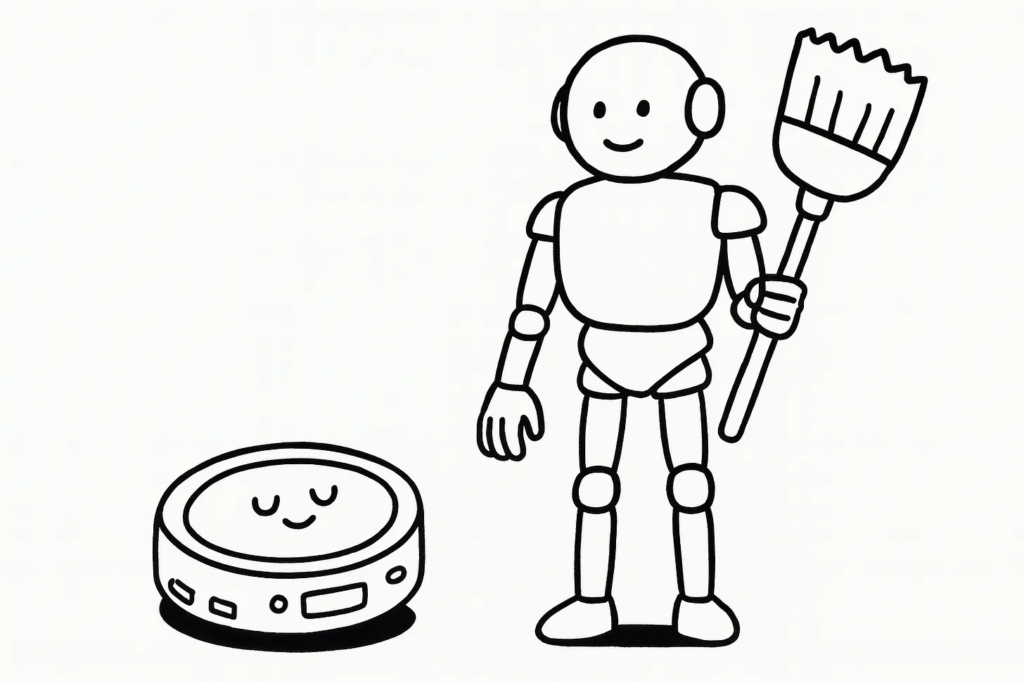
- Robot vacuums glide on wheels; they don’t push a broom.
- Train ticket gates manage flow with sensors; they don’t behave like station staff.
- Elevators move a box vertically; they don’t climb stairs like humans.
- ATMs sort bills mechanically; they don’t mimic a banker’s hand movements.
None of these are humanoid.
History tells the same story. The first washing machines tried to imitate hand-scrubbing; the winners used rotating physics instead. Early aviation mimicked birds; the Wright brothers succeeded by focusing on aerodynamics and control, not imitation.
Optimal shapes naturally diverge from the human form. And just as the optimal physical form isn’t human, the optimal cognitive process isn’t either.
AI Isn’t Imitating Human Thought Either
Another misconception is that AI replicates human thinking.
Inspired by the brain? Yes, but AI is fundamentally a pattern-matching engine, not a system that recreates the causal structure of neural activity or consciousness.
Humans think sequentially under constraints of memory, attention, emotion. AI evaluates vast patterns in parallel, choosing the next word or action statistically.
Its internal method is entirely different. That’s exactly why it excels at speed and coverage.
This leads to a deeper insight. The optimal solution is not always a human imitation.
Not in form. Not in internal mechanics. So “a substitute for a human → shaped like a human” is often a design shortcut.
Designing from Meaning: The Semantic Flow Perspective
The answer is to change the order of thinking. Semantic Flow frames this as:
- Conventional shortcut: “Humans are missing → Let’s find something humanoid.”
- Structural thinking : Meaning → Function → Tool
- Where:
- Meaning: What experience are we trying to fulfill? (i.e. safety, connection, support)
- Function: What abstract capability provides that meaning? (i.e. monitor, notify, carry, guide)
- Tool: What is the best mechanism to deliver the function? (i.e. sensor, call button, lift, mobile base)
Once you think in this order, the solution naturally moves away from humanoids.
Examples: Humanoid Not Required
1. “We want peace of mind.”
- Meaning: Feeling watched over
- Function: Detect anomalies / Notify only when needed
- Tools: Bed sensors, motion detection, emergency buttons
→ No humanoid required.
2. “We want connection.”
- Meaning: Not feeling alone; having someone to talk to
- Function: Respond when called / Connect to family
- Tools: Voice assistants, video calling
→ Again, no humanoid required.
3. “We want to move heavy objects safely.”
- Meaning: Avoid injury
- Function: Lift and transport
- Tools: Power assists, mobile carts, lifts
→ Safer and cheaper than humanoids.
What a Monitoring Sensor Taught Us
One care facility explored communication robots but hit barriers in:
- Expected human-like conversation
- Operational complexity
- High cost
- Psychological resistance (uncanny valley)
Instead, they adopted simple monitoring sensors.
These:
- Reduced workload by notifying only when needed
- Were easy to install and maintain
- Gave staff a sense of “we are truly watching over people”
The need wasn’t “human-likeness.” It was the function of watching over. The sensor didn’t need to smile, it just needed to work reliably.
Why We Still Crave Humanoid Forms
Because often, we are not seeking tools. We are seeking people. At the top of the Semantic Flow chain is meaning, not mechanics.
- Connection: Not feeling forgotten
- Recognition / dignity: Being treated as a person
- Rituals: Greetings, nods, eye contact
- Proxy presence: A sense of someone’s “being there”
These are human needs, not requirements for human form.
Humans have always created ways to fill absence with photos, letters, dolls, stuffed animals, recorded voices. So our attraction to humanoids is understandable. But what we truly seek is not the shape, but the presence and social rituals. This meaning often gets mistaken for a need for human-like form.
Design Options That Avoid Humanoid Shortcuts
1. Create “human presence” at minimal cost
- Function: Small set of social signals (greetings, nods, eye guidance)
- Tool: Avatars, social speakers, animated displays
- Goal: Avoid uncanny valley while providing warmth
Best for: Contexts where social acknowledgment matters but full humanoid capability doesn’t.
2. Augment human ability, not replace it
- Function: AI handles routine / Humans intervene at key moments
- Tool: Monitoring + human call escalation
- Goal: Preserve human density where it matters
Best for: High-stakes environments where human judgment is irreplaceable.
3. Implement “rituals,” not “shapes”
- Function: Social etiquette (timing, pauses, acknowledgment)
- Tool: Voice, light, minimal motion cues
- Goal: Even a box can feel natural if the rituals are right
Best for: Daily interactions where predictability builds trust.
Example: Alexa is not humanoid, yet responding to “Good morning” with “Good morning” makes the interaction feel humanly appropriate. A humanoid robot saying the same words but with a stiff smile might actually feel worse.
The core desire for humanoids is not form, it is meaning.
Why Humanoids Are Getting Attention Now
Because two expectations are mixed:
1. Compatibility expectations (realistic)
Workplaces are built for humans: doors, tools, buttons, pathways. In a transition period, humanoids may be the quickest way to fit existing systems.
2. Proxy-human expectations (unrealistic)
A desire for understanding, empathy, and comfort. Here, the uncanny valley and expectation gaps emerge. That is why humanoids should be chosen by context, not hype.
Where Humanoids Actually Excel
There are areas where humanoid form is sensible.
1. Transitional environments designed entirely for humans
When infrastructure cannot be redesigned immediately.
Note: it is NOT “dangerous work.” Specialized machines are more logical there.
2. Front-facing roles where being seen matters
Reception, guidance, education, entertainment. Where impressions and rituals matter more than operational efficiency.
In these limited contexts, humanoids shine. Everywhere else, optimized non-humanoid designs win.
Measuring Value Requires More Than Numbers
After deployment, track both quantitative metrics (speed, cost reduction, uptime) and qualitative signals that reveal whether you’ve reached the meaning layer:
- Voices such as “This helps”
- More smiles and small talk
- Increased stay time
- Unprompted improvements from staff
These reveal whether the design reached meaning.
Form Follows Meaning
It is natural to crave humanoids during labor shortages. But historically, the tools that truly empowered us never looked human.
- Washing machines do not have hands.
- Robot vacuums do not hold brooms.
- Ticket gates do not have faces.
Identify the meaning. Extract the function. Choose the optimal tool.
The solution to labor shortages does not have to look human. What we seek is connection, safety, dignity, and presence. The shape can come last.
When we design in that order, robots and AI stop trying to replace people and instead become our partners by taking on tasks, creating margin, and giving us back the capacity to be human.
Whatever form those partners take will be the form that meaning brings forth.