
Choosing not to chase technology is the most strategic move of our time.
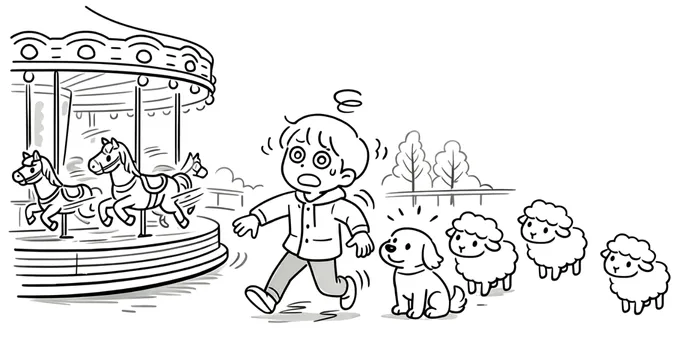
The Carousel Was Meant to Be Slow
A merry-go-round at an amusement park is designed to be gentle. It spins slowly enough for children to wave at their parents and for parents to snap photos. It is safe, enjoyable, and predictable.
But imagine if that merry-go-round suddenly began to spin at extreme speed.
You cling to the pole for dear life. The scenery blurs into streaks of color. You want to get off, but you can’t.
“The next tech is coming!”
“Our competitors just adopted it!”
“We can’t fall behind!”
Those voices keep you spinning. This is the reality for many organizations today. They are exhausted, whipped around by every new tool, clinging to the fading hope that “this time, the tool will save us.”
Speed Has Left the Organization Behind
We have entered a territory where the speed of development has fundamentally broken the old rules.
In the 1990s internet era or the 2000s smartphone era, change was “fast,” but society had a few years to absorb it. Companies and individuals had the luxury of “learning while using.”
Today is different. With Generative AI, you can write code without knowing how to code. With No-Code tools, anyone can build an app. With 3D printers, ideas become physical in hours.
The speed of development has decisively outpaced the speed at which an organization can learn.
This is not a temporary disruption; it is a structural shift. The merry-go-round is never going to slow down again. If you’re still trying to figure out “what this tech can do” and train the entire team before the next wave hits, you’ve already lost.
The Great Inversion: When Tech Becomes a Commodity
The second structural shift is the Democratization of Technology.
Advanced tech used to be the privilege of giants. Now, an individual can create Hollywood-level video or start a global hospitality business without owning real estate.
This has led to a fascinating inversion where huge corporate innovation labs with massive budgets are getting outrun in passion and creativity to individual creators and small teams.
Why? Because possessing the technology is no longer a differentiator. When everyone holds the same sword, the winner is determined not by the sharpness of the blade, but by the clarity of the reason for wielding it.
The Triple Bind
To summarize, we are facing a “Triple Bind”:
- Too Many Choices: By the time you finish mapping the landscape, it’s already changed.
- Short Lifecycles: There is no time for deep, slow consideration.
- No Differentiation: Everyone has access to the same tools.
The old approach, ”Let’s see what this tech can do,” is a trap. Continuing to ride the spinning carousel while looking for the next horse to jump onto is futile.
We must fundamentally reverse our thinking. We must choose to stop chasing.
- Old Way: “What can this technology do?” → Technology-first.
- New Way: “What do we want to realize? What technology serves that?” → Meaning-first.
This reversal is the only sustainable path. In my previous post on “Magic Wand Syndrome,” we explored the disconnect between tools and results. Today, we see that in a high-speed world, starting with “Meaning” is ironically the most efficient shortcut.
The Shepherd and the Sheepdog
Let me offer you a metaphor for the AI era.
Imagine a vast pasture. A shepherd runs around trying to catch every sheep himself. He is exhausted, running left and right, but the sheep scatter.
A skilled shepherd does not run. He stands still on top of a hill. He surveys the entire pasture and gives precise commands to his sheepdogs. “Gather those sheep over there and bring them here.”
In this metaphor, the sheepdogs are AI and automation tools.
Generative AI, data analytics, robots; these are the high-performance sheepdogs. But remember: The sheepdog is not a magic wand. If the shepherd (you) does not clearly define where to gather the sheep, the dog cannot move.
The dog needs clear intent. It needs the shepherd to know the terrain.
In the age of AI, humans do not need to run around the pasture. We need to be the shepherd on the hill. We need a clear intent: “What Meaning do we want to create?” If that meaning is clear, the AI (the sheepdog) will find the optimal route to realize it.
The View from the Hill
The speed of technology will not slow down. The democratization of tech will not stop. You cannot catch up by chasing it.
But this is not despair. It is an opportunity. The high-speed merry-go-round won’t stop, but you can choose to step off.
When you step off and stand on the hill, the blur of motion stops. You can see the horizon. You can see your “Meaning,” the true compass of your organization.
- “We want our frontline workers to feel safe.”
- “We want our customers to feel zero confusion.”
When you anchor yourself in these meanings, you can calmly look at the passing technology and whistle for the right sheepdog.
Ask yourself: The technology your organization is about to introduce… who is it for? What Meaning does it realize? And why is that meaning important?
Stop chasing. Start designing from Meaning. That is how you lead the high-speed revolution.