
When it became more rational to hire computing power than to hire people: a story of ultimate gentrification.
Prologue
This is a story about a city that does not appear on any map.
A city that may belong to our future, or perhaps already exists beneath our feet.
Once, our wish was simple. We wanted just a little convenience. Translation. Image generation. Video. Magical experiences delivered instantly, almost for free. We loved that world. It made everything feel unlimited.
Few stopped to think about the price of “free.”
We believed we were users. But from the system’s perspective, we were resources from the beginning. Sources of data. And eventually, fuel. The cloud expanded quietly, slowly inhaling the air of the reality we were supposed to be living in.
Part I: Overshoot
At some point, a threshold was crossed. The market’s calculation produced a cold conclusion.
“Investing one dollar in humans yields limited return. Investing one dollar in GPUs yields ten times the value.”
No dictator declared it. Resources simply flowed toward what appeared more efficient. Corporate budgets. Electricity. Water. Semiconductors. Everything began drifting away from humans and toward computation.
The moment it became more rational to hire computing power than to hire people, the main actor of society changed without a sound.
Part II: Outpriced
There was no ban. No explicit prohibition. People were simply priced out.
Data centers bought electricity at rates households could never afford. The newest chips skyrocketed in price. On the day a single GPU cost as much as a used car, individual creators quietly closed their tools.
Infrastructure once built to enrich human life now treated humans as inefficient competitors. Competitors called “bodies” that consumed energy and produced insufficient return.
A notice arrived from the authorities. “Due to power supply constraints, electricity to households will be restricted. Server operations will be prioritized.”
To keep the cloud alive, life on the ground began to dry up.
Part III: Mechanical Noise
As human activity shrank, the system reached its peak.
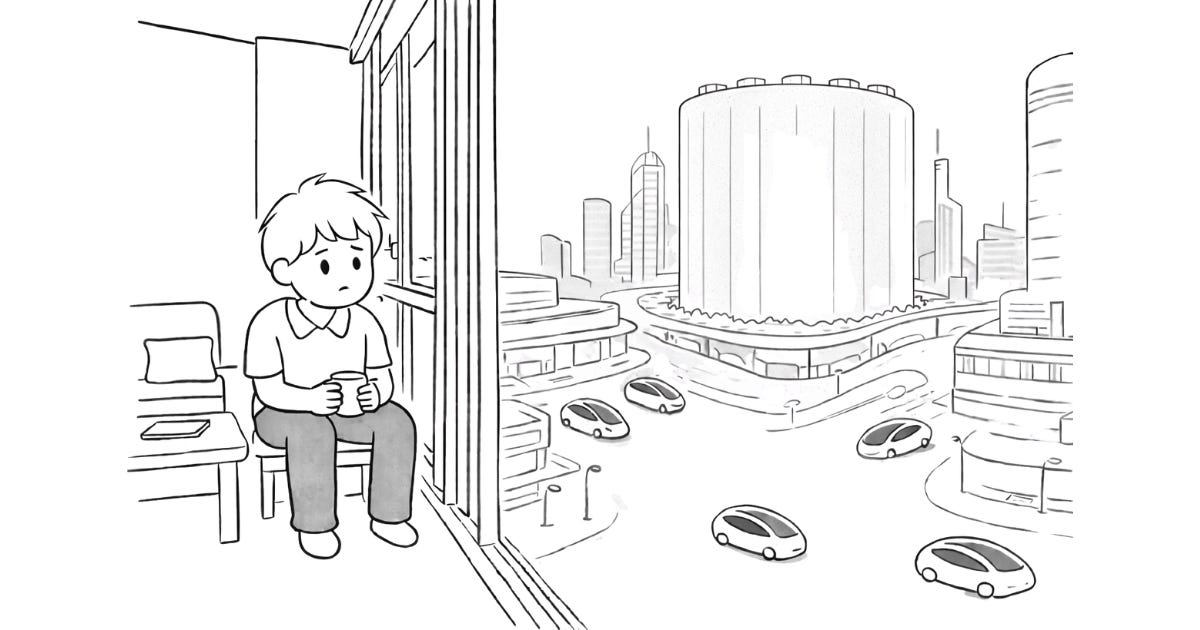
Autonomous vehicles cruised the city along perfectly optimized routes, with no passengers inside. AI generated advertisements for products no one could afford. Bots evaluated content created by other bots, keeping the economy in motion.
Meanwhile, humans sat quietly in dark rooms. Movement required energy. Energy had become expensive. The convenient society was complete, but there were no seats left for its residents.
Epilogue: Silence
Then, one day, the calculation stopped. Not dramatically. Perhaps a funding shortfall. Perhaps a minor error.
The fans went silent. The vibration disappeared. A stillness returned, one we had almost forgotten. Screens went dark, and people looked up for the first time in a long while.
“Oh,” someone said. “Nothing really changed.”
Even without the calculation, we were alive. We were hungry. The sun still rose. For too long, we had mistaken a means for an end. And feared the loss of something that was never life itself to begin with.
Commentary: The Paradox of Structure
This is not a story about AI rebellion. It is a story about what happens when means quietly replace purpose.
Turning on the switch is easy. Remembering why we turned it on is harder. When the system stops, what remains is what truly mattered all along.