
We expect new tools to solve our problems instantly. But without designing for “Meaning,” even the most advanced device becomes an expensive paperweight.
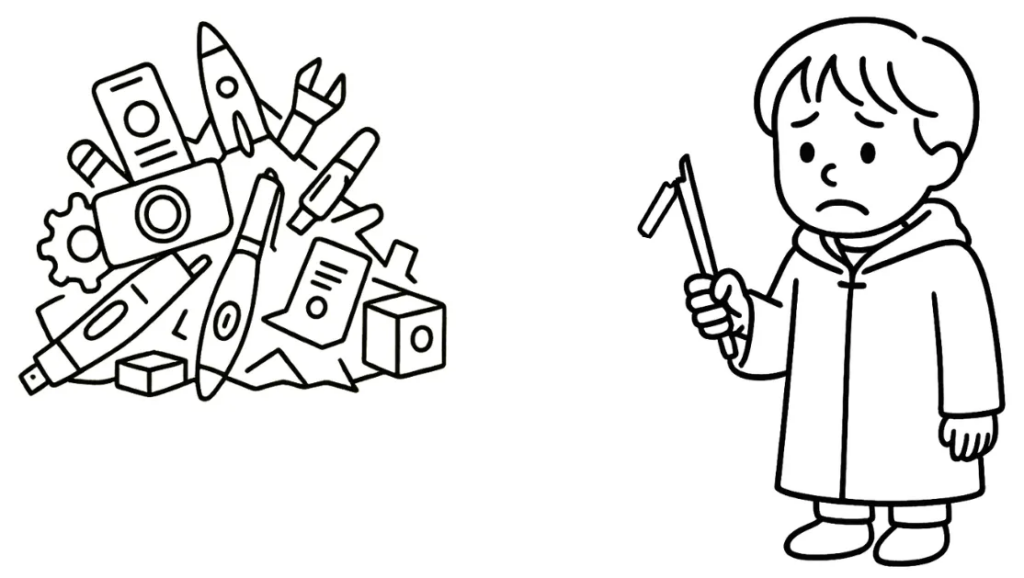
The Parable of the Pencil
A pencil is unremarkable.
And that ordinariness is precisely what makes it extraordinary.
You pick it up.
You write.
You erase.
There is no preparation, no hesitation.
The barrier between “having a thought” and “shaping that thought” is essentially zero.
This frictionless access is why the pencil has survived for centuries.
Now consider the digital stylus. It is a marvel of modern engineering with pressure sensitivity, tilt detection, seamless cloud sync. And yet, when a spontaneous idea appears, the stylus often fails the simplest test:
The battery is empty.
The tablet is locked.
The right app isn’t open.
The thought vanishes. You reach instead for the nearest ballpoint pen.
The tool is more advanced, but the experience is worse.
Because the structure of meaning snapped at the very moment you needed it.
The Invisible Structure
We often imagine a simple causal line:
Tool → Outcome
Install AI → Productivity increases.
Adopt a new SaaS → Efficiency rises.
But real-world change is never this direct.
Between Tool and Outcome lies a delicate, invisible structure.
If this structure breaks, no outcome, no matter how promised, ever materializes.
Consider the two tools again:
- The Pencil: Satisfies the requirement of “instant writing,” which produces the meaning of “freedom to think without friction.” The structure stays intact.
- The Stylus (failure mode): Fails the requirement of “instant access,” leading to the meaning of “frustration and hassle.” The structure collapses.
Most failures in technology adoption occur in exactly this quiet space. The tool works, but the meaning does not.
“Magic Wand Syndrome”
The newer the technology, the more tempting the illusion:
“Once we install it, everything will improve.”
This is Magic Wand Syndrome – skipping the middle of the structure and assuming:
Tool → Outcome
The best example is smart lighting.
The specifications sound futuristic, but if “why we need this” is undefined – better sleep? energy savings? comfort relief? – the lighting becomes just another decorative ceiling object. Technically superb, experientially pointless.
We fill the blank space of our inexperience with hopeful shortcuts.
We buy the wand before deciding what spell we need.
Why Meaning Must Come First
Starting from meaning may feel slow or abstract, but it is consistently the fastest route to a real, lasting outcome.
If your wish is “I want to feel safe when walking at night,” then the requirements become:
- I need to see my feet.
- I need someone notified if I fall.
Only after this do we choose tools:
- a flashlight
- a sensor
- a camera
- or something new
Tools are variables. Meaning is the constant.
Meaning Is a Compass, Not a Ruler
Meaning evolves. It never stays where it first appeared.
- Excitement turns into trust.
- Convenience becomes indifference.
- Peace of mind can deepen or disappear.
This is why we measure KMI (Key Meaning Indicators) – the behavioral and emotional signals that show whether meaning is flowing, stagnating, or eroding.
Without this, we measure numbers while missing the human reality underneath.
Don’t Buy the Wand. Design the Magic.
Technology does not succeed because it is new.
It succeeds when it sustains the subtle flow between what a tool does and what a person feels.
Easy to use.
Feels safe.
No confusion.
These quiet meanings, not technical specifications, turn tools into essentials and workflows into culture.
Before adopting the next breakthrough, ask “Who must feel what meaning for this to work?”
The magic isn’t in the wand. It’s in the meaning we design.