
The hidden reason why tech adoption fails, and why we need to measure “Meaning” before we measure results.
Introduction
“Digital Transformation (DX).”
“AI-driven Innovation.”
Almost every company today rallies behind these slogans. Yet, how often have you seen a business introduce cutting-edge AI tools or robots, only to see the expected results vanish? Instead of efficiency, confusion reigns on the ground.
If you’ve witnessed this scene, you are not alone.
The essence of the problem isn’t the technology itself. The problem is that we are misjudging the impact level of the transformation.
History Repeats Itself: The Lesson of the Electric Motor
What did factory owners do in the early 1900s when the electric motor was first introduced?
They simply swapped steam engines for electric motors. That was it.
They kept the massive steam engine sitting in the center of the factory, with its labyrinth of shafts and belts transmitting power to each machine. They maintained the exact same layout. They had acquired a revolutionary technology called “electricity” but they refused to change the shape of the factory.
The real productivity revolution didn’t happen until decades later.
It was only when factories placed small, independent motors on individual machines and redesigned the entire floor layout to optimize the production flow that the true value of electricity was unleashed.
This story is famous thanks to the research of Stanford economic historian Paul David. He called it the “Productivity Paradox,” showing that there is a significant lag between the arrival of new technology and actual productivity gains.
For us today, this is not just history. It is a warning.
The “Hierarchy” of Transformation
Corporate transformation can be categorized into four levels based on the magnitude of its impact.
Level 1: Tool Replacement – Efficiency of Existing Tasks
- Swapping hand tools for power tools. Moving from paper to PDF.
- This is improvement at the individual task level. The process remains the same; only the tool changes. It has the lowest barrier to entry and offers immediate (though limited) impact.
- In the motor example: This is the phase of simply swapping the steam engine for an electric one.
Level 2: Task Transformation – Changing How We Work
- Moving from handwriting to PC. Shifting from in-person meetings to Zoom.
- Here, individual skill requirements change. You aren’t just learning a tool; you are changing the method of execution.
Level 3: Process Transformation – Redesigning Workflow
- Replacing manual labor with robots. Digitizing entire analog processes.
- Here, organizational roles and scopes of responsibility must change. It requires a redesign of the entire workflow asking “Who does what?” rather than just efficiency.
- In the motor example: This is the phase where the factory layout was finally redesigned to match the production flow.
Level 4: Organizational Transformation – Changing Structure
- Moving from hierarchical to networked organizations. Breaking down silos for cross-functional teams.
- Here, culture and values change. It requires reviewing decision-making mechanisms, evaluation systems, and career paths.
Why We Fail: Applying “Level 1” Thinking to “Level 3” Tech
This is the greatest contradiction modern companies face.
- “Let’s use AI instead of Excel”… This is Level 1 thinking. But the true power of Generative AI lies in redesigning entire workflows (Level 3) or questioning the organization’s very nature (Level 4).
- “Let’s put a robot in the meeting room”… Again, Level 1 thinking.
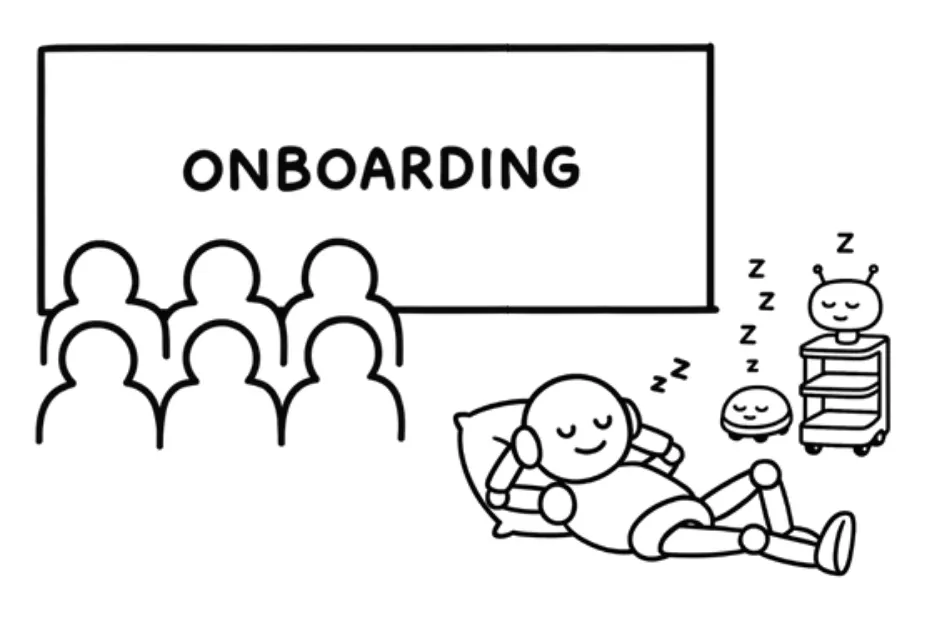
There is a fascinating irony here. Consider what happens when a company hires a new human employee.
We conduct orientations. We create training programs. We assign mentors. We have a handover period. We create job descriptions, clarify reporting lines, and define the scope of authority and responsibility.
We integrate human members with extreme care. Yet, when it comes to robots or AI systems, we somehow expect them to “just figure it out” and be immediately productive.
Robots only truly shine when we fundamentally review the division of labor between humans and machines and reconstruct the entire workflow (Level 3).
- How do we handle the “robot’s orientation”?
- Who defines the “rules of collaboration” with the robot?
- Who takes responsibility when an error occurs?
If you simply “install” the tech without answering these questions, you are breeding chaos.
“Let’s just introduce a DX tool for now.” If you only change the tools (Level 1) without the accompanying business process (Level 3) and organizational culture (Level 4), you are wasting treasure. We are making the same mistake as the factory owners of the 1900s.
Three Principles for Success
So, what should we do?
1. Start by Redesigning the Workflow
When introducing a new tool, don’t ask, “How does this fit into our current way of working?” Ask, “What new way of working does this tool make possible?” You must review the entire process, cut unnecessary steps, and design a new flow.
- If introducing motors: Redesign the layout.
- If introducing robots: Rethink the optimal division of labor between humans and machines.
2. Clarify Organizational Roles and Responsibilities
In this new flow, who is responsible for what? How does decision-making authority change? If this remains ambiguous, you invite confusion and finger-pointing. Just as you would for a new hire, you must clearly define the technology’s “position” within the organization.
3. Design from “Meaning”: The Semantic Flow
Most importantly, transformation must be designed starting from the “meaning” people feel.
Is this an efficiency project? Or is it a qualitative shift in customer experience? Is it for cost reduction, or new value creation? Whether this fundamental meaning is shared and flows consistently through the organization determines success or failure.
When the structure is sound, the “why” connects everything from high-level strategy to on-the-ground operations. When the CEO’s vision, the manager’s process design, and the frontline’s daily tasks all exist on the same “flow of meaning,” people accept change and become drivers of it.
Conversely, if this flow is broken, the frontline is left asking, “Why are we being made to do this?” No matter how superior the technology, without shared meaning, transformation becomes a hollow shell.
To measure this, Semantic Flow uses KMI (Key Meaning Indicators). Unlike KPIs which measure results, KMIs capture the signs of meaning; feelings like “reassurance,” “pride,” or “trust.” We look for the movement of meaning before the movement of numbers.
Conclusion
Technology is evolving at an accelerating pace. However, there is a massive gap between the speed of technological evolution and the speed at which organizations can change.
The key to bridging this gap is to correctly identify the impact level of the transformation. Level 3-4 technologies require Level 3-4 adoption approaches.
It took decades after the electric motor arrived for the productivity revolution to occur. We don’t have to walk that same path. We can learn from history.
Changing tools is easy. But real transformation starts with redesigning the workflow, reviewing roles, and above all, sharing the meaning of the change across the entire organization.
Ask yourself: The “cutting-edge technology” your organization is about to introduce…what is its true impact level? Are you taking an adoption approach that matches it? And does the meaning of that transformation flow to every corner of your organization?
The answers to these questions will decide your success.