
Why a bare fluorescent bulb in a dining room explains the failure of digital transformation.
Fluorescent Nights in the Dining Room
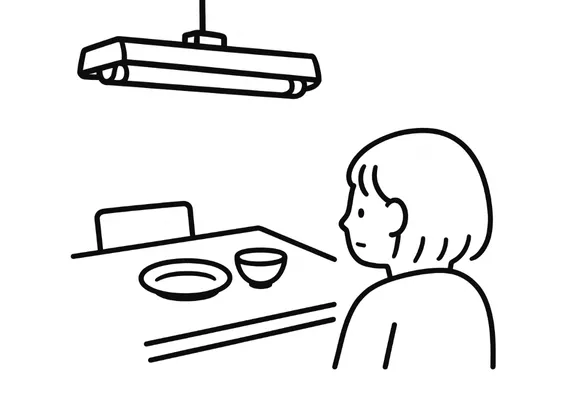
One night, the light in our dining room broke. The next morning, my father brought home a replacement: a bare, old-fashioned fluorescent tube without a cover.
“It’s bright enough, isn’t it?” he laughed.
Technically, he was right. Measured the lux levels, it was probably just as bright as before. But as we sat down for dinner, the air felt strangely cold. The contours of my family’s faces looked sharp and hard under the white glare.
It was bright, yet the mood was dark.
This strange contradiction emerges when we mistake a tool’s Function for the Meaning it creates in human experience.
Same Light, Different Meanings
The purpose of lighting as a tool is simple: to illuminate.
However, depending on how that light is delivered, the meaning we receive changes completely.
- Streetlights: Illuminate dark roads → Safety
- Ambient Lighting: Soft, diffused light → Relaxation
- Desk Lamps: Focused brightness → Immersion / Focus
- Emergency Lights: Lights that work during outages → Reassurance
Even though they are all “lights,” the Experience (E) and Meaning (M) they generate are entirely different. This gap is often where the disconnect between technology and people begins.
The Rise and Fall of Fluorescence
We must not forget that the fluorescent light was once a symbol of modernity.
In the 1950s, it represented progress, abundance, and the future. Compared to incandescent bulbs, it was brighter, longer-lasting, and efficient. It brought “the brightness of a new era” to households.
But today, that same light often signifies something else: sterility, efficiency over comfort, and alienation.
The function (brightness) hasn’t changed. Only the Meaning has shifted completely. What was once a symbol of the future is now, in many contexts, a symbol of being out of touch.
When the “Semantic Flow” Breaks
If we look at my father’s fluorescent light through the lens of Semantic Flow, the structure of the failure becomes clear:
- Tool (T): Bare fluorescent tube
- Requirement (R): “As long as it’s bright, it’s fine.” (Function-focused)
- Experience (E): A cold, sterile dining room where conversation dies.
- Meaning (M): Discomfort, fatigue, efficiency-only.
- Outcome (O): A silent, awkward dinner.
My father’s mistake was looking only at the Function (making it bright) and failing to imagine the Experience and Meaning that would follow.
Designing for the Heart, Not Just the Eyes
This isn’t just a story about light bulbs. The exact same structure appears in corporate DX (Digital Transformation) projects.
A company introduces a new system. Statistically, efficiency goes up. KPIs are met. The report says “Success.” But on the ground, employees are exhausted, conversations decrease, and creativity vanishes.
Just like the fluorescent light in the dining room, the office is “bright (efficient) but cold.” The Tool (T) became the goal, leaving Experience (E) and Meaning (M) behind.
We tend to talk about tools in terms of specs and efficiency. But what people really seek is: “How will I feel spending time in that light?”
Designing brightness isn’t about deciding the lumen count. It is about designing the structure of Meaning including the conversations, the silence, and the flow of time that happens in that space.
Start with Meaning. That is the first step to escaping the era of cold, bare efficiency.